
What is XRF?
An introduction to this versatile technology
Popular for its relatively low-cost of acquisition, ease of use, and limited sample preparation, Energy Dispersive X-ray Fluorescence (ED-XRF) technology is a popular piece of test equipment for many application needs.
The following provides a brief answer to the question...What is XRF?
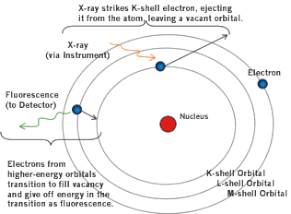
When sufficient energy light waves (x-ray or photon) are absorbed by an atom, the inner shell electrons are excited to an outer shell or removed completely. The empty inner shell that remains is ‘filled’ by electrons from an outer shell of the atom.
The difference in energies between the two shells involved is excess energy; which, when generated in this process, is emitted as radiation (fluorescence). In a given element the energy difference between two specific orbital shells is characteristic of that element and is always the same.
The difference in energies between the two shells involved is excess energy; which, when generated in this process, is emitted as radiation (fluorescence). In a given element the energy difference between two specific orbital shells is characteristic of that element and is always the same.
Therefore, the emitted light wave will always have the same energy...by determining the energy emitted by a particular sample, XRF spectrometers are able to identify the element(s) involved.
The Major XRF Components
There are three major parts in XRF analyzers that affect performance and capabilities. First, an x-ray source known as an x-ray tube (generally 40-60kV, 50-300W) emits an x-ray beam into the sample being analyzed. After this beam excites and displaces electrons the resulting energy that is characteristic to the element is emitted as a wavelength and collected by another critical component, the detection system (commonly referred to as the detector tube). The type of XRF detector tube varies in each model, providing different benefits that suite a particular testing need. A last component is the software package; which is based on algorithms developed for specific applications and processes the information collected by the detection system.
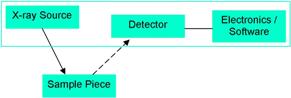
The components utilized are important for an instrument’s daily performance (accuracy, speed, repeatability) and the analyzers long-term life. Eastern Applied Research selects only top performing components for XRF repair services and has teamed with manufacturers that source only reliable components for the new analyzers offered.
XRF Compared to Other Analytical Techniques
Other methods of elemental analysis or chemical characterization (atomic absorption, inductively coupled plasma spectroscopy, wavelength dispersive XRF) are either destructive, require massive units, are limited in function, or are too expensive when compared to the energy dispersive x-ray fluorescence model. The benefits of ED-XRF in comparison make it the preferred method for a variety of applications needs.
Hitachi High-Technologies, Distribution and Support
The Hitachi XRF line is the evolution of the popular Seiko XRF line and Eastern Applied Research is pleased to provide sales and service across the United States, Canada, and Mexico. Known for high precision, innovation, and analyzer longevity, the Hitachi line excels at ultra thin coating measurements because of its poly-capillary optics and offers high throughput because of the lines Vortex detectors.
Hitachi XRF FT Series: Quality Control in Coating Thickness
(coating thickness, composition, plating bath monitoring)
Hitachi XRF EA Series: Process Control Testing
(RoHS testing and Process Control)
Other methods of elemental analysis or chemical characterization (atomic absorption, inductively coupled plasma spectroscopy, wavelength dispersive XRF) are either destructive, require massive units, are limited in function, or are too expensive when compared to the energy dispersive x-ray fluorescence model. The benefits of ED-XRF in comparison make it the preferred method for a variety of applications needs.
Hitachi High-Technologies, Distribution and Support
The Hitachi XRF line is the evolution of the popular Seiko XRF line and Eastern Applied Research is pleased to provide sales and service across the United States, Canada, and Mexico. Known for high precision, innovation, and analyzer longevity, the Hitachi line excels at ultra thin coating measurements because of its poly-capillary optics and offers high throughput because of the lines Vortex detectors.
Hitachi XRF FT Series: Quality Control in Coating Thickness
(coating thickness, composition, plating bath monitoring)
Hitachi XRF EA Series: Process Control Testing
(RoHS testing and Process Control)